Recently, the paper titled “Dynamic Priority Queue-based Scheduling Algorithm for TSN-CAN Gateways” by the research team led by Associate Professor Wu Wufei from our school was accepted and officially published at the 22nd International Conference on Embedded Wireless Systems and Networks (hereinafter referred to as EWSN 2025). The paper was co-first-authored by graduate students Li Wenhao and Li Min, with Wu Wufei serving as the corresponding author. Nanchang University is the sole affiliated institution.

EWSN (International Conference on Embedded Wireless Systems and Networks) is a top-tier international academic conference in the field of embedded wireless systems and networks. Founded in 2004, it was initially co-organized by several renowned European universities and research institutions (such as ETH Zurich, TU Delft, KU Leuven, etc.) with the aim of advancing fundamental research and practical applications in wireless sensor networks (WSN) and embedded systems. This year’s conference emphasized the theme of “Artificial Intelligence of Things (AIoT),” featuring a dedicated track on “Artificial Intelligence of Things” to encourage submissions on integrated AI and IoT systems and applications, such as TinyML, edge intelligence, and the application of generative models in embedded networks. The paper was presented orally at EWSN 2025 held in Leuven, Belgium, marking a new breakthrough in academic research and disciplinary development for Nanchang University’s computer science field and further expanding the international influence of the university’s computer science discipline.
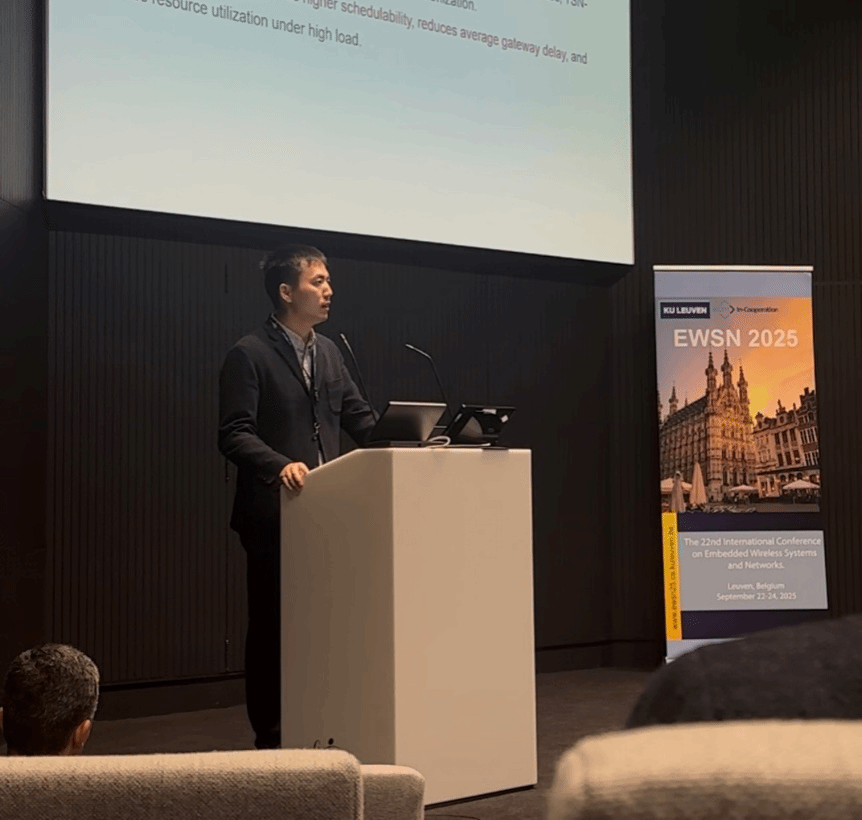
Associate Professor Wu Wufei Presenting at the Conference
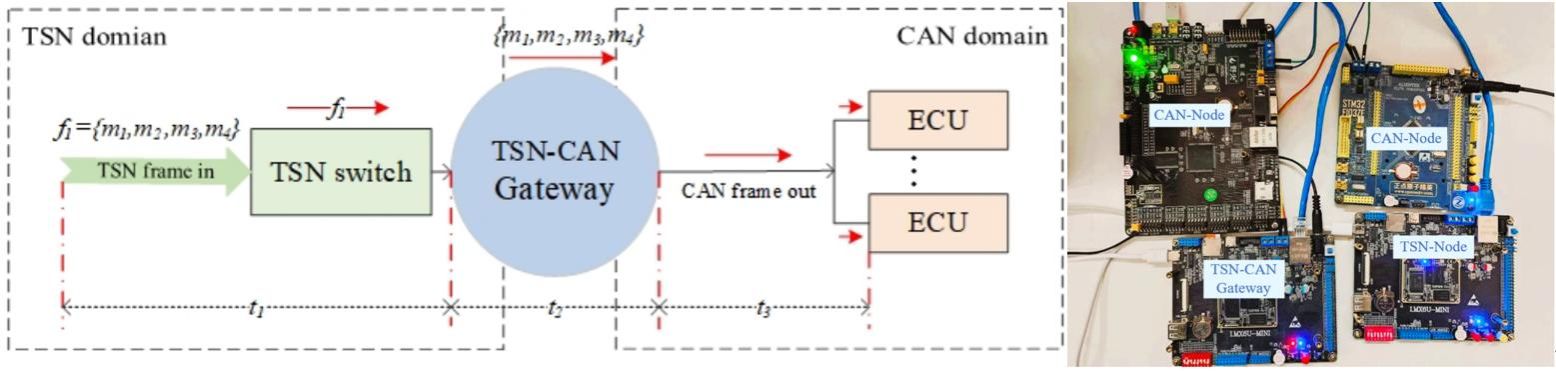
Addressing the critical component of in-vehicle networks amid the current trends of automotive intelligence, electrification, connectivity, and shared mobility, this paper focuses on the bandwidth and real-time performance bottlenecks of traditional CAN buses. It proposes a dynamic priority queue (DPQ)-based frame scheduling algorithm for TSN-CAN heterogeneous gateways. By establishing a mapping relationship between CAN frames and dynamic priority queues and introducing a queue lifecycle management mechanism, the algorithm enables dynamic allocation of message priorities and the recovery scheduling of timeout frames. This approach effectively improves gateway resource utilization while ensuring real-time performance. The significance of this research lies in providing a feasible and efficient scheduling solution for the integration of next-generation in-vehicle Ethernet with traditional buses, overcoming congestion bottlenecks caused by transmission rate mismatches in heterogeneous networks.
Experimental validation shows that this method significantly improves message schedulability and system stability under high-load scenarios. In the future, the algorithm can be widely applied in intelligent driving domain controllers, in-vehicle Ethernet gateways, and multi-domain integrated communication systems. It provides key technical support for achieving in-vehicle networks with higher bandwidth, lower latency, and stronger robustness, holding important engineering application prospects for ensuring real-time communication in vehicle-to-everything (V2X) and intelligent connected vehicle systems.
Link to the EWSN 2025 Acceptance: https://www.ewsn25.cs.kuleuven.be/program/accepted-papers



 Address:No. 999 Xuefu Avenue, Honggutan District, Nanchang City, Jiangxi Province
 TEL:0791-83968083
 0791-83968083