

Position: HOME > ABOUT US > Brief Introduction
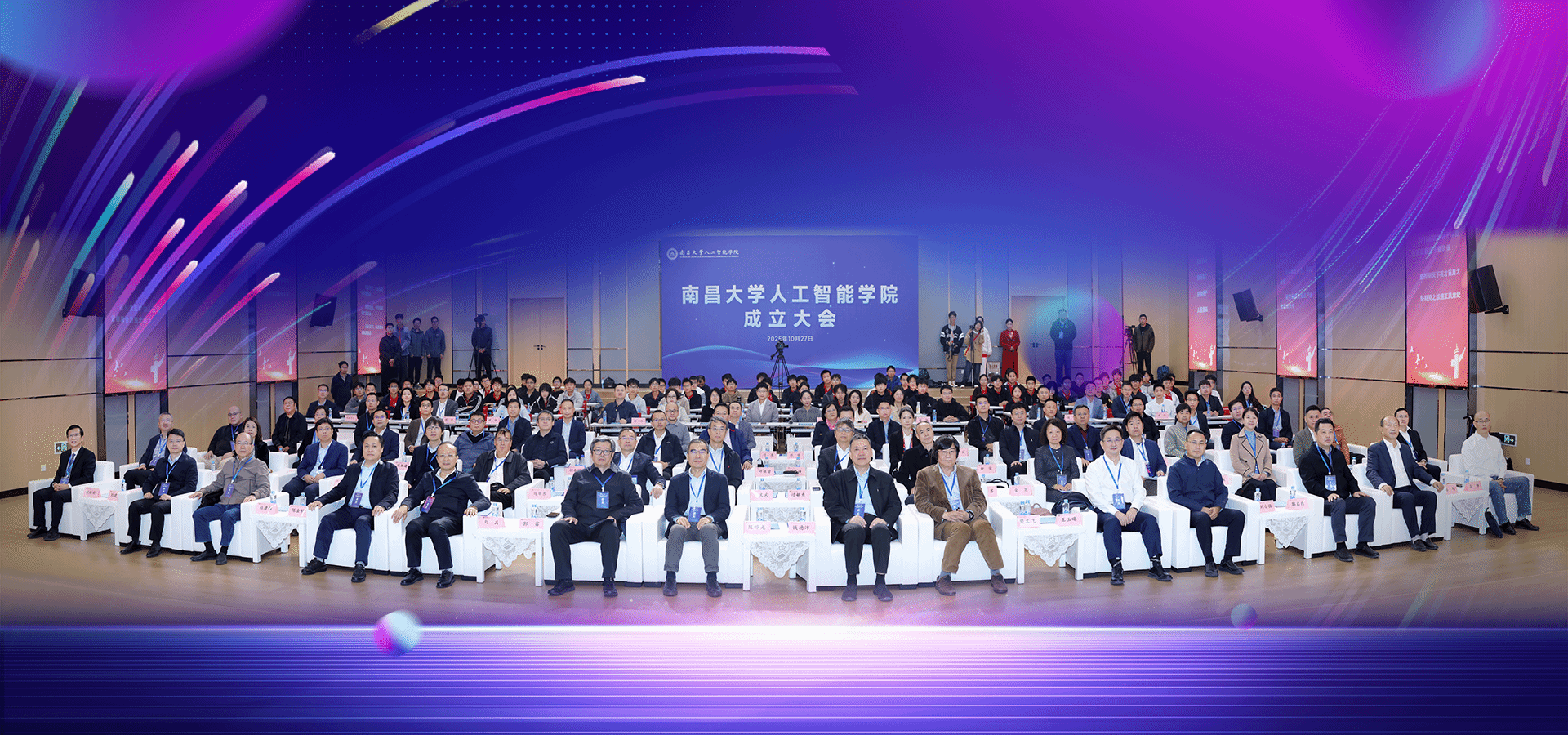
The School of Artificial Intelligence at Nanchang University is a distinctive new engineering college established by the university in response to national strategies and through the integration of superior resources. It was officially inaugurated in October 2025. Guided by the principles of "solid foundation, broad scope, and emphasis on practice," the school’s program development aims to cultivate interdisciplinary talents equipped with both research innovation and industrial application capabilities.
I.Background and Orientation of Program Development
The Artificial Intelligence program at Nanchang University was established in 2019 as a key initiative in response to China’s "New Generation Artificial Intelligence Development Plan" and the Ministry of Education’s new engineering education reforms. Leveraging the university’s high-quality teaching resources, the school has built a talent cultivation system characterized by "government guidance, interdisciplinary integration, and university-enterprise collaboration." Its goal is to nurture top-tier talents with engineering practical abilities, international perspectives, and systematic thinking for the field of artificial intelligence. The program was officially approved in 2020, and in the same year, the "Elite Class" was established in collaboration with Baidu Songguo, incorporating corporate resources to strengthen practical teaching.
II. Cultivation Model and Features
The school employs the "Three Realities" teaching model (real-case analysis, real-environment training, and real-project evaluation) to enhance students’ comprehensive abilities through personalized AI learning plans, research training, and corporate internships. Undergraduate students are required to complete 166.5 credits (including 6 non-degree credits), with core courses covering mathematics, programming, algorithms, and cutting-edge AI technologies. Key features of the cultivation model include:
University-Enterprise Collaborative Training: Partnerships with companies such as Baidu enable students to participate in real project development.
Competition and Research-Driven Learning: The school organizes discipline competitions such as the "Internet+" contest. In recent years, undergraduate students have collectively published 9 high-level papers and obtained 8 patents.
International Perspective: Academic forums and special training camps are organized to connect students with global cutting-edge technologies.
III. Curriculum System and Core Modules
The curriculum focuses on three major modules: mathematical foundations, engineering skills, and cutting-edge technologies. Key courses include:
Mathematics and Natural Sciences: Advanced Mathematics, Linear Algebra, Probability Theory.
Engineering Foundations: Python/C++ Programming, Circuits and Electronics.
Professional Core Courses: Machine Learning, Deep Learning, Reinforcement Learning, Computer Graphics.
Interdisciplinary Integration: Signals and Systems, Modern Control Theory, Intelligent System Optimization.
IV. Student Development and Career Prospects
Graduates pursue careers in internet technology companies, AI startups, and traditional industries undergoing transformation:
Technology Companies: Engaging in algorithm design, data mining, and intelligent recommendation system development.
Healthcare and Manufacturing: Applying technologies such as assisted medical imaging diagnosis and intelligent production scheduling.
Entrepreneurship and Research: Some students further their studies at top-tier universities or join research institutions. In recent years, students have won over 100 awards in competitions (including more than 50 provincial second prizes or above), demonstrating significant employment competitiveness.
Through systematic curriculum design, practice-oriented teaching models, and close university-enterprise collaboration, the School of Artificial Intelligence at Nanchang University has become an important base for new engineering education in China.
*Data as of July 13, 2026

 Address:No. 999 Xuefu Avenue, Honggutan District, Nanchang City, Jiangxi Province
 TEL:0791-83968083
 0791-83968083

Copyright: School Of Artificial Intelligence NanChang University